We Are TRANSFORMING Lives


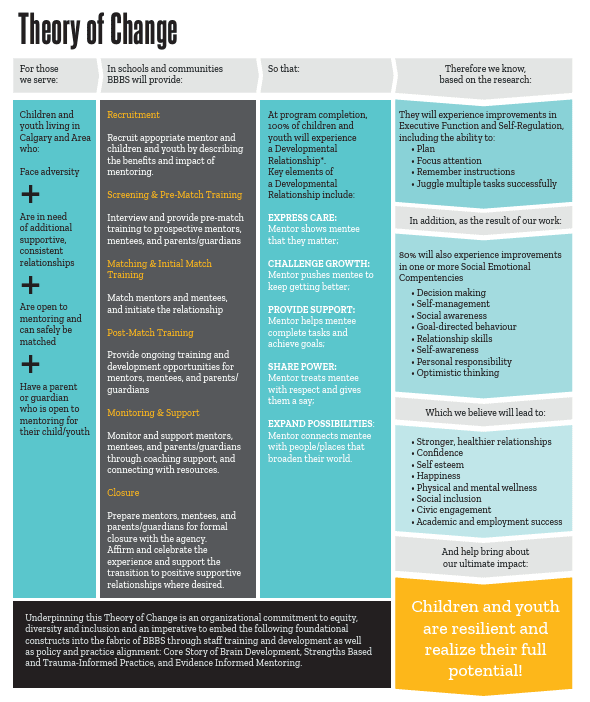
Mentors form relationships with their mentees that develop their social-emotional learning and executive functioning skills.

These critical Developmental Relationships help young people to become resilient, and give them the confidence to achieve more.
Snapshot of Our Impact
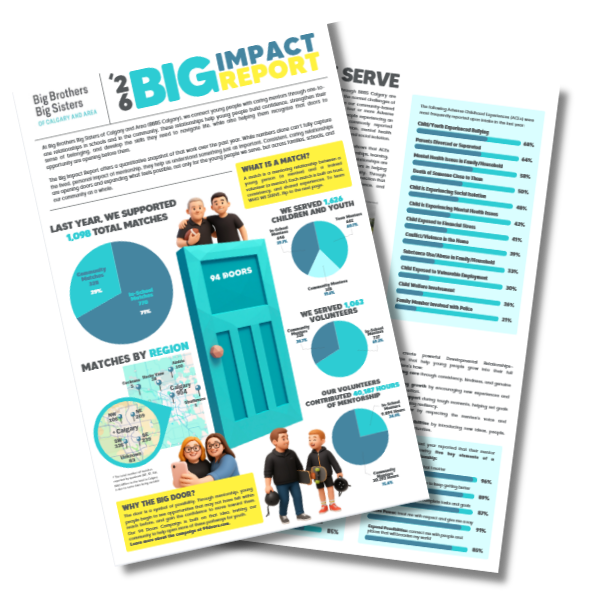
Last year, we supported 1,098
total matches
WHAT IS A MATCH?
A match is a mentoring relationship between a young person (a mentee) and a trained volunteer (a mentor). Each match is built on trust, consistency, and shared experiences. To learn WHO WE SERVE, scroll down!
Last year, we supported 1,626
CHILDREN AND YOUTH
Last year, we supported 1,063
VOLUNTEERS
The Big Impact Report
The Big Impact Report is our annual snapshot of how mentorship is changing lives in Calgary and Area. Backed by research and grounded in real relationships, this report shows the power of mentoring, one match at a time.
Looking fOR More than a snapshot?
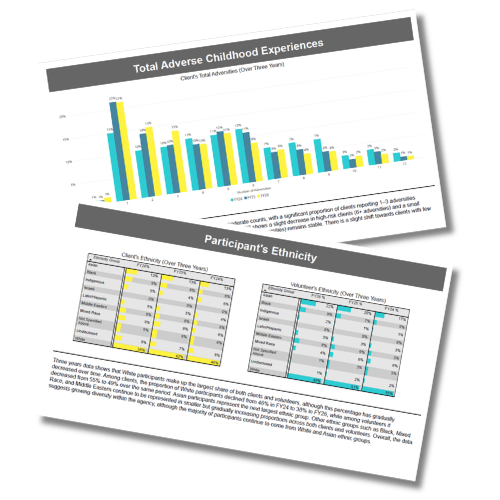
For those who want to dive deeper into our impact, the Annual Performance Report provides a comprehensive look at the data behind mentorship. Explore detailed statistics, trends, and analysis below.
How Do We Measure the Need for Mentorship?
Adverse Childhood Experiences, or ACEs, were developed by the U.S. Centers for Disease Control and Prevention and Kaiser Permanente to assess an individual’s exposure to toxic stress related to abuse, neglect, and household dysfunction during the first 18 years of life. In order to gain a better understanding of the children and youth we serve, and their families, we collect information at intake relating to socio-emotional competencies and ACEs, which act as a benchmark for where a child is and where they will go over the course of a Developmental Relationship. Although the questionnaire is not intended to be a diagnostic tool, research suggests that the higher the ACE score, the greater the risk for that individual to develop physical, social, and behavioural problems.
According to the Alberta Adverse Childhood Experiences Study done in 2013, children that suffer trauma, such as abuse, neglect, living in a home where there is violence, or having a parent who is mentally ill risk being twice as likely to have conditions like obesity, cardiovascular disease, addiction, and depression as adults. The study found that ACEs rarely occur in isolation:





Charity Intelligence


Impact Genome


TrecLab / University of Calgary
In partnership with TREC Lab and the University of Calgary, we are working to bridge the knowledge gap about the long-term impacts of mentoring relationships within the unique Canadian landscape.